Rockwool Insulation Dealer in Bangalore
Rockwool Insulation is a mineral-fibre material used inside false ceilings, drywall partitions and other building assemblies where thermal and acoustic performance matter. Also called stone wool or mineral wool, it is supplied as slabs or mats and fitted within the construction rather than used as a decorative finish. EchoPro Acoustics supplies Rockwool insulation for residential and commercial projects, including offices, theatres, studios and sound-sensitive interiors across Bangalore and South India.
When comparing a Rockwool Insulation supplier, dealer or manufacturer in Bangalore, consider the intended use, thickness, density, dimensions, pack coverage and technical documents. EchoPro Acoustics supports architects, contractors, designers and acoustic consultants with inquiries for ceiling insulation, partition infill and soundproofing assemblies. Rockwool can improve a correctly designed system, but gaps, doors, lightweight linings and flanking paths still affect results. Request a quotation for the specific grade and project quantity.


What is Rockwool Insulation?
Rockwool Insulation, also called mineral wool or stone wool, is a fibrous material made from mineral raw materials. Its porous structure helps slow heat transfer and dissipate acoustic energy inside a suitable cavity. For ceiling insulation, slabs may be placed above a suspended ceiling; for partition infill, they fit between framing members before boards are closed. Where a project also needs a visible absorbing finish, Rockwool may be installed behind a suitable facing or alongside finished Acoustic Panels.
Unlike polyester wadding, Rockwool is a mineral-fibre product with grades designed for different building uses. Thickness, density, facing and fire classification vary, so check the datasheet for the supplied grade. Acoustic treatment manages reflections inside a room, while sound isolation limits transmission through a construction. Learn about acoustic treatment before deciding where cavity insulation or exposed absorbers are needed.
Why Choose Rockwool Insulation
EchoPro Acoustics helps customers choose Rockwool for the full assembly, not thickness alone. Where a project also needs an exposed decorative absorber, compare its role with PET Polyester Acoustic Panels. We can discuss application, density, quantity, delivery location and compatibility with framing and lining boards. EchoPro supplies acoustic and soundproofing products in Bangalore and across South India for individual buyers and project teams.
Sound Absorption for Ceiling and Partition Cavities
Rockwool’s fibrous structure helps absorb a portion of incident sound energy when correctly installed. In partitions and ceilings it can help reduce cavity resonance and support a better designed acoustic assembly; results depend on the full system and not only the insulation slab.
Thermal Insulation Support
Rockwool is also used to slow heat transfer through suitable ceiling and wall assemblies. The thermal result depends on thickness, density, thermal conductivity, installation continuity, air leakage and the performance of the rest of the building envelope.
Density Options for Different Applications
Different densities and product formats suit different construction needs. The supplier listings include grades such as 48, 64 and 96 kg/m³; confirm which densities, thicknesses and dimensions are currently available for the intended project.
Useful for Drywall Partition Infill
Rockwool slabs can be fitted in the cavity between partition studs to add an absorptive layer. The wall still needs suitable board layers, properly sealed perimeters and carefully detailed junctions to achieve its intended sound-isolation performance.
Suitable for Designed Ceiling Systems
Above a false ceiling, Rockwool can form part of a concealed insulation build-up. For exposed finishes that also contribute to room acoustics, it may be paired with a suitable facing or an architectural product such as Wood Wool Acoustic Board, selected for the design and tested assembly.
Supply in Bangalore and South India
EchoPro Acoustics receives inquiries for Rockwool Insulation from Bangalore, Karnataka and neighbouring South Indian markets. Quantity and packing can be reviewed against slab size, thickness, density and the location where material is required.
Application-Focused Product Support
The right grade for a false ceiling may differ from the grade selected for a high-performance partition. Discuss the cavity depth, framing, lining, moisture conditions, thermal objective and any fire-documentation requirements before confirming the order.
Guidance for Complete Assemblies
Rockwool performs as one element of a larger construction system. EchoPro can help buyers understand the role of cavity insulation and complementary materials so that sound absorption, sound isolation and thermal requirements are considered separately and accurately.
Contact Us
Rockwool Insulation is widely used in
Rockwool Insulation is widely used as a concealed layer in ceiling insulation, partition infill and acoustic or thermal assemblies. It may be fitted above suitable suspended ceilings, between drywall studs or inside designed enclosures. Its role is to add absorption and insulation, while boards, seals, framing and junction details provide the other parts of system performance.
Rockwool may be specified in offices, conference rooms, studios, theatres, hotels, educational facilities and other places where noise transfer or heat gain needs attention. EchoPro Acoustics supplies Rockwool in Bangalore and across South India. Check density, thickness, dimensions and technical literature because acoustic and fire performance are not identical across every grade.
- False Ceiling Insulation
- Drywall Partition Infill
- Soundproofing Assemblies
- Auditoriums and Theatres
- Home Theatres and Media Rooms
- Recording and Music Studios
- Conference and Meeting Rooms
- Schools and Educational Institutions
- Hotels and Hospitality Projects
- Commercial Offices
- Hospitals and Healthcare Facilities
- Plant Rooms and Service Enclosures
- Residential and Multi-Unit Buildings
Typical Applications of EchoPro Rockwool Insulation
Rockwool Insulation can be used in residential, commercial and selected industrial systems requiring ceiling insulation, thermal resistance or acoustic cavity infill. It is normally enclosed behind boards or ceilings, so the result depends on framing, perimeter seals and finish layers. Common applications include:
Partition Infill for Soundproofing
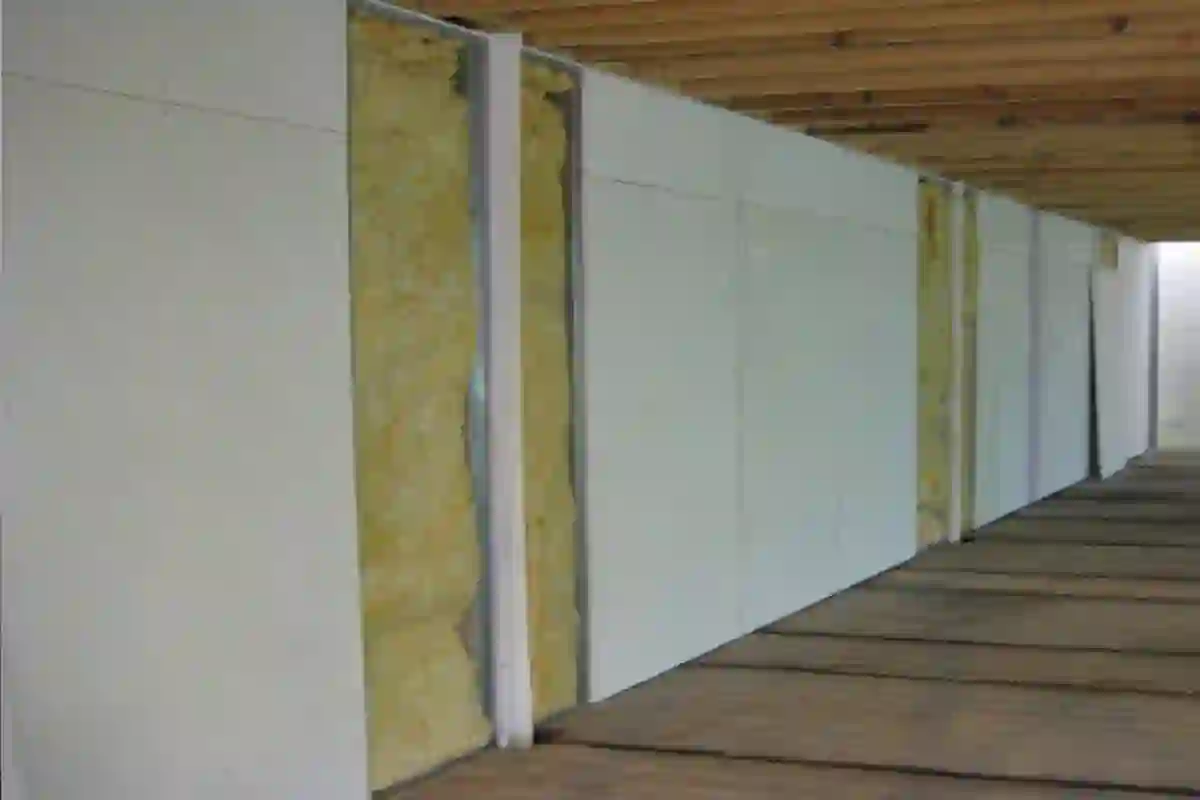
Rockwool Insulation is an effective infill material for drywall partitions, helping reduce sound transmission between adjoining rooms. Installed within the cavity between partition boards, its dense, fibrous structure absorbs sound energy and helps improve the acoustic performance of the wall assembly.
False Ceiling Insulation
Rockwool Insulation is installed above false ceilings to help reduce heat transfer and improve indoor thermal comfort. Its fibrous structure also absorbs sound, helping minimise noise transmission between floors and from building services. It is ideal for offices, commercial buildings, hotels, auditoriums and other spaces requiring effective thermal and acoustic insulation.
Infill Behind Acoustic Wall Panels
Rockwool may be used as a concealed core in acoustic panels when the frame, facing and retention system are suitable. It is not a visible finish by itself. Select panel depth for the intended frequency range and follow product safety instructions. PU Foam Acoustic Panels are another type of room-surface absorber with a different composition and use case.
Recording and Music Studios
Its dense, fibrous structure absorbs sound energy, helping control reverberation and improve the acoustic environment for recording vocals, instruments and audio production. It works best when combined with properly designed soundproofing layers and acoustic treatment for clearer recordings and better sound isolation.
Conference and Meeting Rooms
Rockwool Insulation is installed inside partition walls and above false ceilings in conference and meeting rooms to help reduce noise transmission between adjoining spaces. Its sound-absorbing properties help minimise echo and improve speech clarity, making discussions, presentations and online meetings easier to follow.
Classrooms and Educational Institutions
Rockwool Insulation is installed inside partition walls and above false ceilings in classrooms and educational institutions to help reduce noise transmission between classrooms, corridors and adjoining spaces. Its sound-absorbing properties help minimise unwanted noise and reverberation, improving speech clarity so students can hear teachers more clearly.
Hotels and Hospitality Spaces
Rockwool Insulation is installed within partition walls and above false ceilings in hotels and hospitality spaces to help reduce noise transmission between guest rooms, corridors and common areas. Its sound-absorbing properties help minimise unwanted noise, creating a quieter and more comfortable environment for guests.
Restaurants and Cafés
Rockwool Insulation is installed inside partition walls and above false ceilings in restaurants and cafés to help reduce noise transmission between dining areas, kitchens and adjoining spaces. Its sound-absorbing properties help minimise echo and excessive noise from conversations, kitchen equipment and busy dining areas, creating a more comfortable atmosphere for customers.
Libraries and Reading Rooms
Rockwool Insulation is installed inside partition walls and above false ceilings in libraries and reading rooms to help reduce noise transmission from adjoining spaces and corridors. Its sound-absorbing properties help minimise unwanted noise and reverberation, creating a quieter environment that supports concentration, reading and studying.
Gyms and Fitness Centres
Rockwool Insulation is installed inside partition walls and above false ceilings in gyms and fitness centres to help reduce noise transmission from workout areas to adjoining rooms and neighbouring spaces. Its sound-absorbing properties help control reverberation and reduce noise build-up from conversations, music and fitness activities.
Rockwool Insulation is installed inside partition walls and above false ceilings in co-working spaces and shared offices to help reduce noise transmission between workstations, meeting rooms and adjoining areas. Its sound-absorbing properties help minimise unwanted noise and reverberation, creating a more comfortable environment for focused work, discussions and virtual meetings.
Commercial and Service Areas
Rockwool Insulation is installed inside partition walls and above false ceilings in commercial buildings and service areas to help reduce noise transmission between offices, utility rooms and adjoining spaces. Its sound-absorbing properties help minimise unwanted noise from equipment, ventilation systems and daily operations, improving acoustic comfort.
Technical Specifications of Rockwool Insulation
Material
Mineral wool / stone wool fibres
Thickness
50mm
Slab Dimensions
2 ft × 3 ft slab
Colour / Appearance
Green
Sound Absorption (NRC)
up to 0.90
Density Grades
50, 64 and 96 kg/m³
Thermal Conductivity
<0.040 W/(m.K) at 25 Degree Celsius
Max Temperature Resistance
-195 to 250 Degree Celsius
Fire Safety
In Accordance with BS476
Coverage
96 Kg Density: 65 Sft / Bag
Typical Applications
False ceilings, partition infill, acoustic and thermal insulation assemblies
Brands
Rockwool India
Sunrock
Polybond
Rhino
Acoustic Performance of Rockwool Insulation
Rockwool Insulation improves acoustic performance through its interconnected, fibrous structure, which converts a portion of airborne sound energy into heat through friction and viscous losses as air moves through the material’s microscopic pores. When installed inside drywall partitions, Rockwool fills the cavity between wall boards and reduces sound energy travelling through the enclosed air space. It also helps dampen cavity resonances, limiting the amplification of certain frequencies that can otherwise pass through hollow partitions.
The overall improvement in sound insulation depends on factors such as Rockwool thickness and density, partition cavity depth, the mass of the wall boards, airtightness, and the use of resilient channels or decoupled framing. A properly designed partition assembly can therefore reduce speech noise and improve privacy between offices, conference rooms, studios and other adjoining spaces. However, Rockwool alone does not make a wall completely soundproof; flanking paths, gaps around doors, electrical outlets and structural connections must also be addressed.
When installed above false ceilings, Rockwool helps absorb sound within the ceiling cavity and can reduce sound transmission between floors or adjoining spaces when incorporated into a suitable ceiling-floor assembly. Its porous fibres dissipate sound energy entering the material, while the insulation layer can help control cavity resonance and improve the acoustic behaviour of suspended ceiling systems. In combination with ceiling boards, sealed joints, appropriate suspension systems and, where required, resilient isolation, Rockwool can contribute to improved airborne sound insulation and reduced noise transfer from services or occupied spaces.
It is important to distinguish sound absorption from sound insulation: Rockwool absorbs sound within a space or cavity, whereas the complete wall or ceiling assembly determines how effectively sound is blocked from passing through. Actual performance varies with thickness, density, installation quality and construction details, and should be assessed using relevant laboratory test data, such as the Sound Transmission Class (STC) or weighted sound reduction index (\(R_w\)) for the complete assembly.
Also, click to read about our complete guide to acoustic treatment, review Polywool Insulation as an alternative to Rockwool insulation.
Important Notes When Buying Rockwool Insulation
Rockwool Is Not Complete Soundproofing by Itself: It can absorb sound in cavities but does not seal gaps or provide all the mass needed for isolation. Depending on the design, it may be combined with Magnesium Oxide Board and a barrier such as Mass Loaded Vinyl Sheet. The complete build-up must match the noise source and site conditions.
Select Suitable Thickness: 50 mm stock is commonly listed, while other sizes depend on brand and availability. Match thickness to cavity depth and system requirements; do not compress slabs unless the specified design allows it.
Confirm Density and Grade: Supplier listings include 48, 64 and 96 kg/m³ grades, but availability and properties vary. Use the current datasheet rather than choosing by density alone.
Plan the Installation Detail: For ceilings, check suspension loads, clearances, access panels and services. For partitions, fit slabs neatly and ensure the lining boards can be installed as designed.
Consider the Whole Room: Room size, doors, glazing, flooring, wall finishes, ceiling construction and noise sources all influence the result. Where the objective is better room acoustics, combine cavity insulation with appropriately located absorbers and a considered treatment strategy; do not expect cavity insulation alone to solve every reflection or privacy issue.
Understand Noise Type: Low-frequency noise, impact vibration and structure-borne sound may need additional measures. Identify whether the project needs absorption, thermal insulation, sound isolation or several goals together.
Verify Fire and Safety Documents: Ratings differ by grade, facing and system. Request the current fire classification and test reports for the exact product, and follow the project specification and local requirements.
Buy for the Application: Ceilings, partitions and equipment enclosures may require different grades. When comparing a Rockwool Insulation manufacturer, supplier or dealer in Bangalore, confirm the brand, dimensions, density, pack quantity and delivery terms.
Compare Rockwool Insulation Price Fairly: Price varies with thickness, density, slab size, brand, quantity and delivery. Request a defined specification and compare cost per covered area only after confirming actual pack coverage.
Confirm the Specification: Verify the product name, manufacturer, thickness, density, slab dimensions, pack coverage, thermal data and required acoustic or fire documents. This prevents confusion between grades sold under the general Rockwool description.
Installation Guide for Rockwool Insulation
Plan Rockwool installation around the ceiling, partition or acoustic assembly. Before work begins, confirm thickness, density, cavity dimensions, slab size, pack coverage, support method and technical documents. Follow the manufacturer’s instructions and approved project details, especially where services, fire requirements and sound isolation matter. Fit Rockwool without large gaps or excessive compression. Keep it dry during storage, use suitable handling procedures and do not obstruct electrical, HVAC, fire detection or access points. For ceilings, confirm the support system and service clearances; for partitions, install the infill before closing the final board layer.
Step 1 – Check the Cavity and Prepare the Area
Inspect the partition frame, ceiling grid or panel assembly before fitting Rockwool. Remove debris, check that the cavity is dry and verify its depth and framing spacing. Identify protrusions and service routes, then confirm the slab fits the approved detail and operating conditions.
Step 2 – Measure and Plan the Layout
Measure the area and calculate quantity using confirmed slab dimensions and pack coverage. Plan cuts around studs, beams, openings and services while avoiding narrow pieces that may shift. Keep ceiling panels, lights and access hatches serviceable, and support insulation as specified.
Step 3 – Use Appropriate Handling and Cutting Methods
Cut slabs using methods recommended for the material. Use suitable personal protective equipment and follow the manufacturer’s safety guidance for dust or fibres. Choose supports, retainers or mechanical fixings approved for the product and assembly rather than an unverified adhesive.
Step 4 – Position and Secure the Insulation
Place Rockwool in the designated cavity with close joints and no large gaps. Avoid excessive compression or loose placement that could shift. Keep clear of services where required, detail penetrations as specified and close the wall or ceiling only after the infill is checked.
Step 5 – Inspect the Completed Work
Inspect corners, joints and service penetrations to check continuity where required. Ensure slabs remain in place, unintended voids are absent and boards can be finished correctly. Complete any required photographs or documentation before closing the assembly.
Professional Installation Recommended
Professional installation is recommended for commercial spaces, studios, auditoriums, plant rooms and complex ceiling or partition systems. An experienced contractor can coordinate density, framing, ceiling loads, board layers, service penetrations and sound-isolation details. For projects in Bangalore and South India, contact EchoPro Acoustics to discuss supply and grade requirements.
Contact Us
#6, 10th B Cross, Jayswal Center, KHB Main Road, Kaveri Nagar, Kanakanagar, RT Nagar Post, Bangalore – 560032.
Email Address:
sales@jayswalgroup.com
anil@jayswalgroup.com
jayswal1@yahoo.co.in